
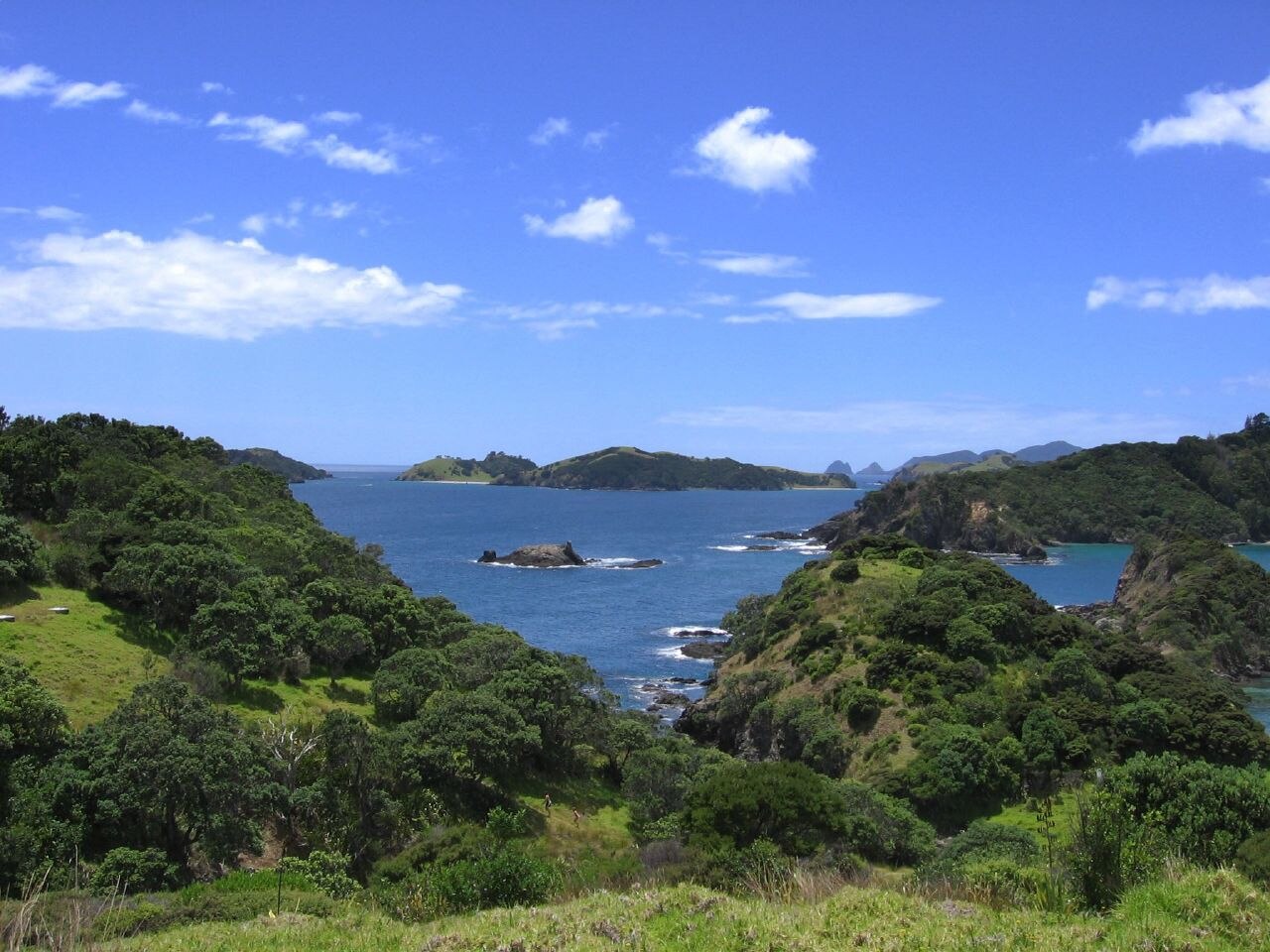
Bay of Islands
144 subtropical islands, and the place where modern New Zealand was founded.
Pēwhairangi — the Bay of Islands — is a warm, sheltered maze of 144 islands in the Northland region, three hours north of Auckland. It is a sailing and diving destination, and it is also the single most historically important place in the country.
Waitangi
On 6 February 1840 the Treaty of Waitangi was signed here between the British Crown and Māori rangatira. It remains New Zealand's founding document and the subject of its longest-running argument.
The Waitangi Treaty Grounds hold Te Whare Rūnanga, a carved meeting house representing all iwi rather than one, and Ngātokimatawhaorua, a 35-metre ceremonial waka that requires 80 paddlers and is launched each Waitangi Day.
The hell hole of the Pacific
Russell — Kororāreka — was New Zealand's first European settlement and briefly its capital. As a whaling port in the 1830s it acquired a reputation for lawlessness that earned it the nickname the hell hole of the Pacific.
It is now a quiet, extremely pleasant waterfront village. Christ Church, built in 1836, is the oldest surviving church in the country and still carries musket holes from the 1845 Battle of Kororāreka.
Nearby Kerikeri holds the Stone Store (1836), New Zealand's oldest stone building, and Kemp House (1822), its oldest building of any kind.
On the water
Boat trips run out to Motukōkako — the Hole in the Rock — at Cape Brett, and pass through the arch when the swell allows. Bottlenose and common dolphins are resident; orca pass through regularly.
Big-game fishing was popularised here by the novelist Zane Grey in the 1920s and the marlin season still runs January to April. Divers head for the Rainbow Warrior, the Greenpeace vessel bombed by French agents in 1985 and later scuttled at the Cavalli Islands, where it is now a thriving artificial reef.
Header photograph by Fuadounet via Wikimedia Commons, licensed CC BY / CC BY-SA.