
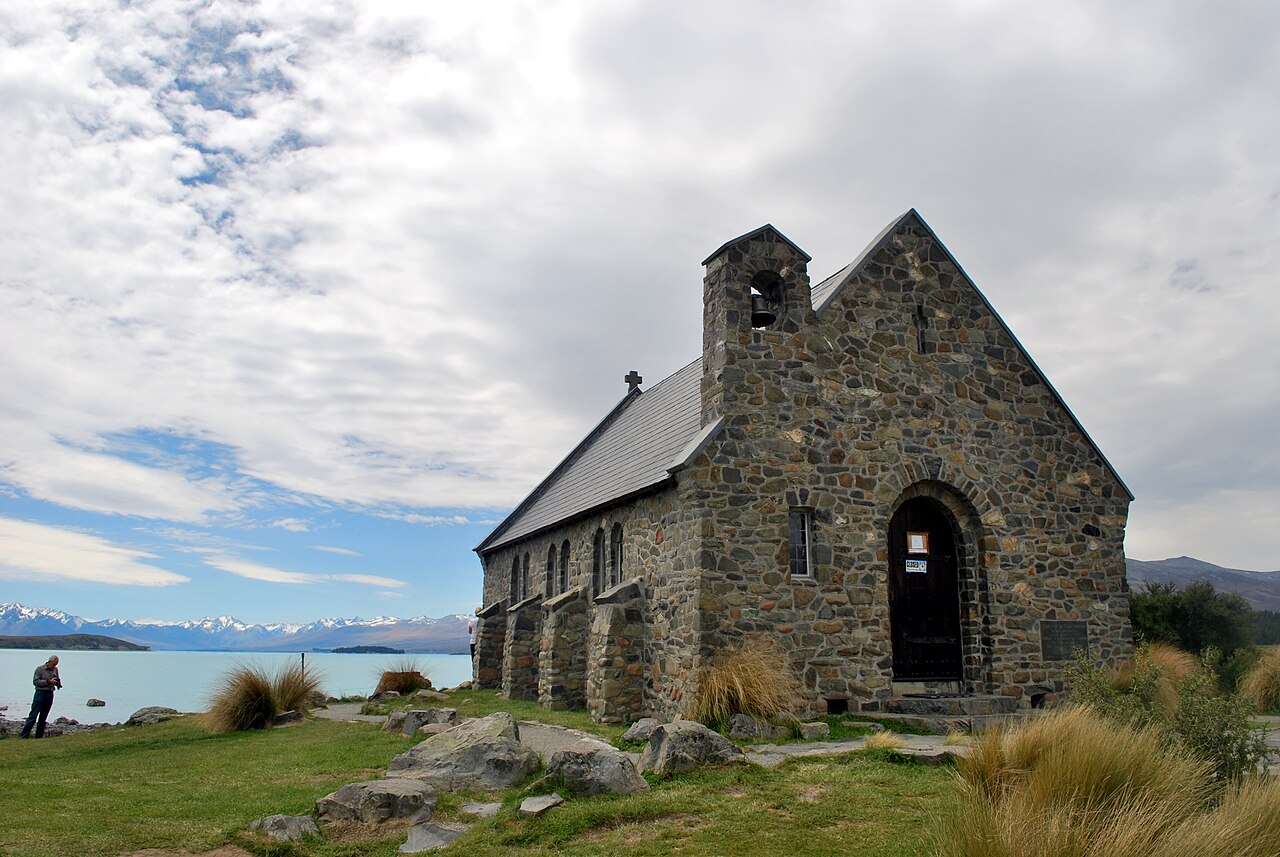
Lake Tekapo
Impossibly turquoise water by day, one of the world’s best skies by night.
Takapō sits in the wide brown Mackenzie Basin roughly halfway between Christchurch and Queenstown. The lake is an unreal opaque turquoise, and above it is one of only a handful of gold-standard International Dark Sky Reserves on the planet.
Why the water is that colour
Glaciers grinding against bedrock produce an extremely fine sediment called rock flour. It washes into the lake and stays suspended rather than sinking, scattering the blue-green part of the spectrum back at you.
The effect is strongest in bright light and shifts noticeably through the day. The neighbouring lakes Pūkaki and Ōhau do the same thing, fed by the Tasman and Hopkins glaciers.
The most photographed church in New Zealand
The Church of the Good Shepherd was built in 1935 from stone gathered within a five-mile radius. Its altar window frames the lake and the Southern Alps deliberately, with no stained glass to get in the way.
Nearby stands a bronze collie, erected in 1968 to acknowledge the sheepdogs without which the high-country runs of the Mackenzie could not have been worked.
The Aoraki Mackenzie Dark Sky Reserve
Designated in 2012 and covering 4,300 square kilometres, this is one of the largest dark sky reserves anywhere and holds the gold tier. Local lighting has been controlled since the 1980s to protect observatory work.
The University of Canterbury's Mt John Observatory sits on the hill above the township and runs guided night tours. On a clear moonless night you can see the Magellanic Clouds, the Southern Cross, and the core of the Milky Way with the naked eye.
In late November and December the roadsides fill with Russell lupins in pink and purple. They are an introduced weed that ecologists would rather be rid of, and they are also the reason for half the photographs ever taken here.
Header photograph by Mattinbgn via Wikimedia Commons, licensed CC BY / CC BY-SA.