
Waitomo Glowworm Caves: 45 Minutes, 140 Years of History
A Māori chief and an English surveyor rafted into the dark by candlelight in 1887. The tour you take today follows their route.
In December 1887, a local Māori chief named Tāne Tinorau and an English surveyor named Fred Mace built a flax raft, took candles, and floated into the hole where the Waitomo Stream disappears underground. What they found overhead — thousands of points of blue-green light stretching into the dark — is the same thing you are taken to see today, and the modern tour follows very nearly the route they took.
What the 45 minutes actually consist of
The standard experience is the guided 45-minute tour, and it has a deliberate three-part shape. It opens in the upper level of the cave among the limestone formations, moves down through the Cathedral — a chamber with a reputation for acoustics that guides will usually demonstrate — and finishes at the water, where you board a small boat in near-total darkness.
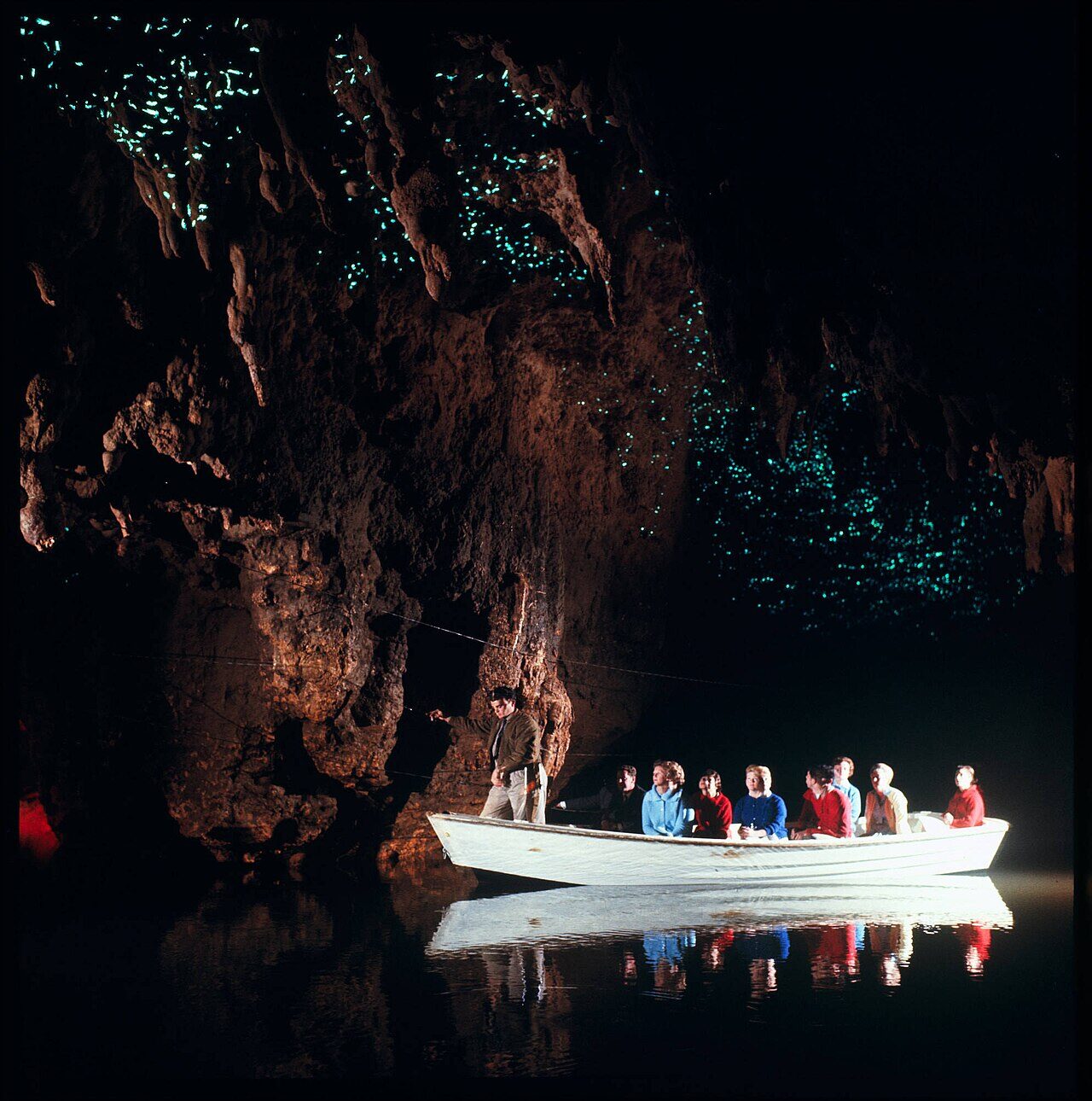
That final section is the reason people come. The boat is pulled silently along by the guide using overhead ropes rather than a motor, and the roof above resolves into what looks convincingly like a night sky. It lasts a few minutes. It is worth the other forty.
The glowworms are not worms, and the light is not friendly
Arachnocampa luminosa is found only in New Zealand, and it is not a worm at all — it is the larval stage of a fungus gnat. The light is bioluminescence produced in the larva’s tail end, and it exists for one reason: to lure smaller insects into the silk fishing lines the larva hangs beneath itself. Prey mistake the glow for an exit to open sky, fly upward into the threads, and are hauled in.
A dense, brilliant grotto ceiling is therefore not a sign of a thriving happy colony so much as a very effective trap, and hungrier larvae glow brighter. Knowing that does not spoil it. It makes the ceiling considerably stranger to look at.
It also explains the rules. Noise and light both suppress the glow, which is why the boat section is conducted in enforced silence with no photography. Visitors sometimes read that as heavy-handed; it is simply the condition under which there is anything to see.
Who owns the cave
This is the part most visitors never hear, and it is the most interesting thing about Waitomo. By 1889, two years after that first candlelit raft trip, Tāne Tinorau had opened the cave to visitors himself — he and his wife Huti guided groups through personally for a small fee. It was, in the most literal sense, a family business.
In 1906 the government took over administration of the cave. It stayed in state hands for the better part of a century. Then in 1989 the land and the cave were returned to the descendants of the original owners, and today many of the staff and guides are descended from Tāne Tinorau himself. Very few natural attractions anywhere have that arc — found, commercialised, appropriated, returned — and the guides will tell you about it if you ask.
Fitting it into a route
Waitomo sits in the Waikato, inland and south of Auckland, and it works best as a stop on the way between somewhere and somewhere else rather than a destination in itself. The natural pairing is with Rotorua and the geothermal country to the east, or as a first-day stop heading south out of Auckland.
The 45-minute tour is the classic and the right choice for most people. Waitomo is also the home of black-water rafting — floating the underground river on an inner tube — for anyone who wants the same cave system with considerably more adrenaline and considerably colder water.
Header photograph by Michael Willison via Wikimedia Commons · CC BY 2.5.